How to choose a travel eSIM plan: fixed data or unlimited?

Start with your destination, trip length and internet use: maps and messaging, streaming, or work calls. Then compare the plan details. For a fixed-data plan, check the total data allowance for your trip. For unlimited data, check the daily full-speed allowance and the speed after you use it. With either option, check validity, the total price and top-up availability.
Here is how to read a plan card and compare options in the eSIM.bar catalogue.
Fixed data vs unlimited: what is the difference?
| What to compare | Fixed-data plan | Unlimited plan with a daily full-speed allowance |
|---|---|---|
| Data allowance | A total amount of data for the validity period | A daily full-speed allowance, followed by reduced speed |
| Usage across days | Use more on some days and less on others, within the total allowance and validity | The daily full-speed allowance matters on busy days |
| Price | The price of the selected package | If priced per day, calculate the cost for all your days |
| Top-ups | If available: data and days | If available: days |
“Unlimited” alone does not tell you the speed you will get. A longer validity period for a fixed-data plan does not mean a fresh data allowance every day.
How does a fixed-data eSIM work?
An illustrative 10 GB plan valid for 30 days gives you 10 GB in total during its validity period. It does not give you 10 GB each day. You can use more on a sightseeing day and less on a day spent near Wi-Fi: usage comes out of the same total allowance.
Both data allowance and validity need to fit your trip. A plan may still be within its validity period when all its data has been used. Conversely, unused data does not mean you can keep using the plan after it expires. Do not assume automatic extensions or rollover unless the terms confirm them.
If you are unsure how much data you need, start with our guide to estimating travel data usage. The next step is to check whether the total allowance and validity fit your activities and travel dates.
What does unlimited data with reduced speed mean?
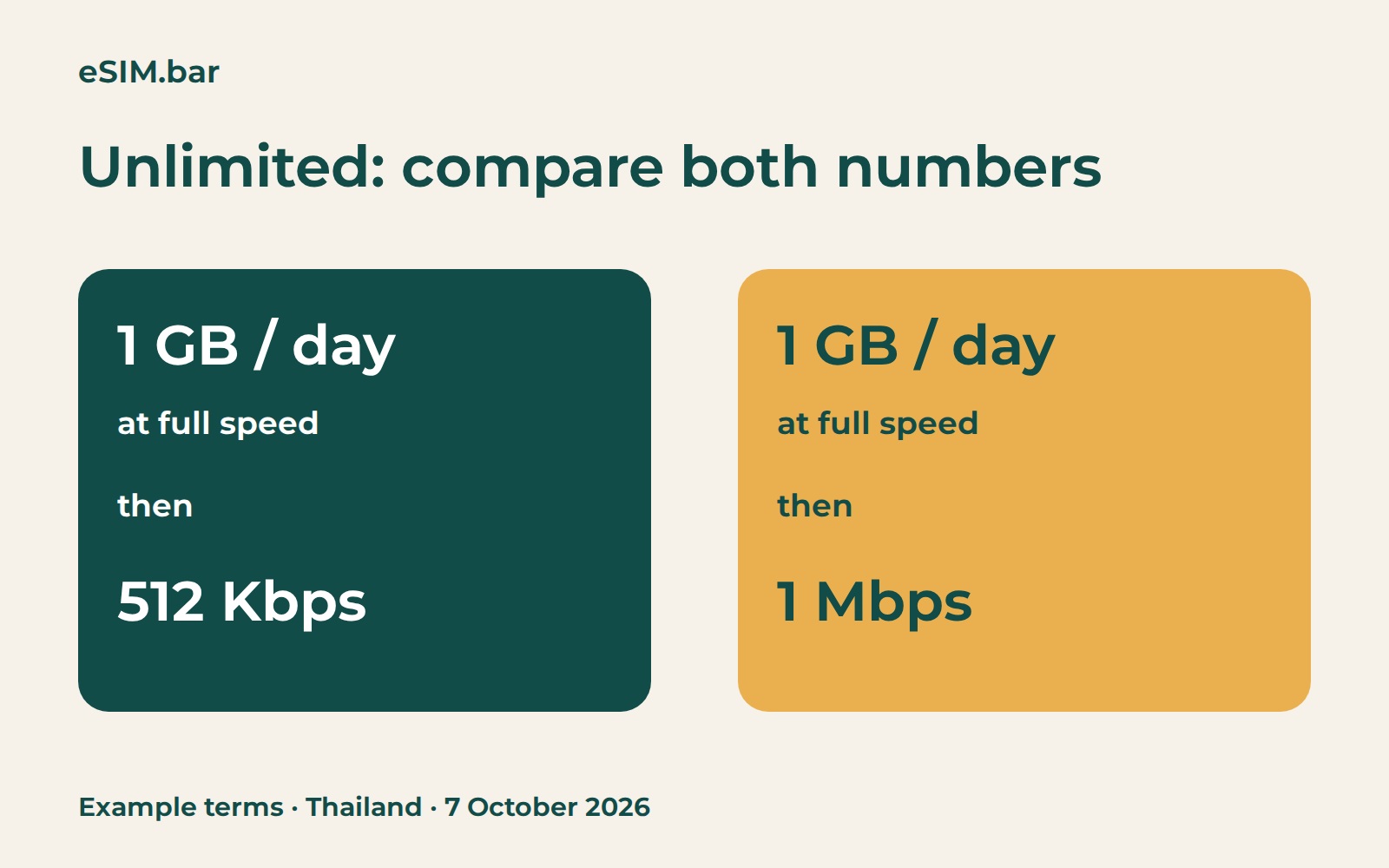
A plan card might say “1 GB per day at full speed → then 1 Mbps.” After you use that daily full-speed allowance, internet access continues at a reduced speed. This does not promise full speed throughout your trip.
Compare two separate conditions:
- The daily full-speed data allowance. This matters if you stream, upload files or make video calls during the day.
- The reduced speed afterwards. Plans with the same daily allowance can have different speeds after you use it.
For example, the Thailand catalogue includes 1 GB per day → 512 Kbps and 1 GB per day → 1 Mbps. The allowance is the same; the reduced speed differs. These examples were checked on 7 October 2026. Before buying, check the current Thailand plan terms.
Full speed also depends on the network and connection conditions. A stated reduced speed does not guarantee how a particular app or video call will perform. If reliable performance matters for your work, consider the full-speed allowance as well as the “unlimited” label. Check when the daily allowance resets for your specific plan; do not assume it resets at midnight in your time zone.
Which eSIM plan suits your activities?
Maps, taxis and messaging. Estimate your total usage and check fixed-data plans that cover the entire trip. If usage is predictable, compare total data, validity and the full price.
Social media and video. Think about your busiest day. A larger fixed-data package lets you use the total allowance unevenly across days. With an unlimited plan, compare expected daily usage against the full-speed allowance: downloads may slow down once you use it.
Work, video calls and large files. Check speed restrictions as well as data. If you need internet on a laptop, confirm whether tethering is supported by the specific plan. Neither “fixed data” nor “unlimited” proves that hotspot use is allowed.
Travel across several countries. First check the regional plan's actual country list. A region name is not a substitute for its coverage details. Then compare data, validity and price.
How much will your eSIM cost for the whole trip?
Compare plans for the same travel dates. If an unlimited plan is priced per day, multiply that price by the number of days you select and check the final total before paying. For fixed data, use the full price of a package that meets both your data and validity needs.
For a 10-day trip, compare the total for 10 days of unlimited data against the full price of a suitable fixed-data package. If you expect to buy extra data, include the cost and conditions of available top-ups. A lower daily price does not necessarily mean a cheaper trip.
Can you top up an eSIM with data or extra days?
Top-ups depend on the specific offer. Both fixed-data and unlimited plans can be non-rechargeable. Look for “Top up available” or “No top up” on the plan card.
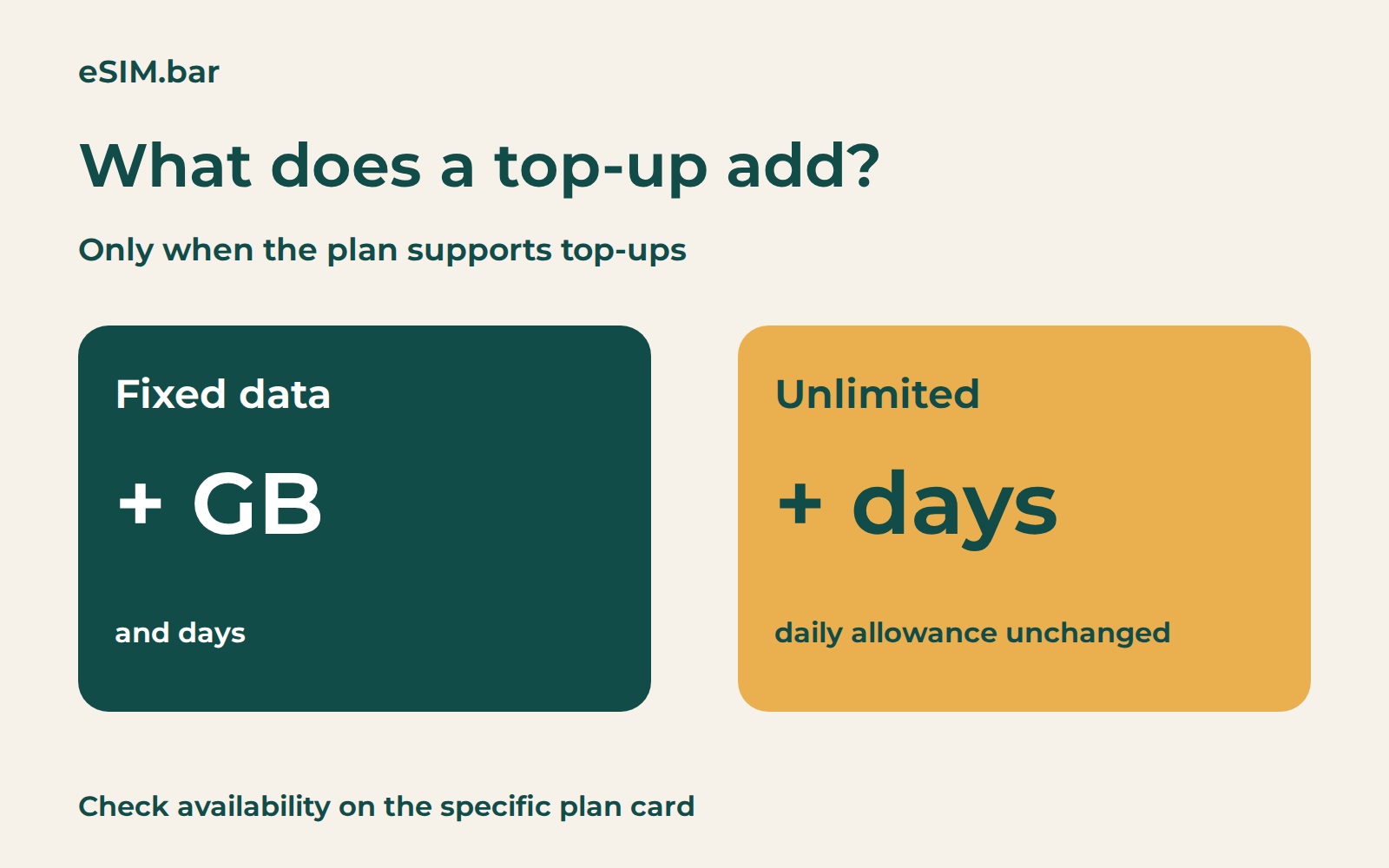
- For fixed-data plans, where top-ups are available, they add data and days. The amount and validity depend on the top-up package you choose.
- For unlimited plans, where a top-up is offered, it adds days. It does not mean a larger daily full-speed allowance.
The second point explains how such a top-up works; it does not promise that rechargeable unlimited plans are available for every destination. Check the plan card before buying. For an eSIM you already own, check the available offers in the “Top up” section of your eSIM account. Review how the top-up takes effect; do not assume that remaining data or validity periods are automatically combined.
If a plan cannot be topped up, do not expect an extra payment to restore its data or extend its validity. You will need to choose another available offer to stay connected.
What should you check before buying?
- Coverage: every country on your route should be included.
- Data: the total fixed allowance or daily full-speed allowance.
- Reduced speed: what happens after the full-speed allowance is used.
- Validity and billing start: first installation or first network connection, as stated for the selected plan.
- Top-ups: whether they are available and what they add.
- Total cost: for all your days and the data you need.
Before purchasing, check your phone's eSIM compatibility. Install your eSIM in advance at home with a stable internet connection, following our iPhone and Android installation guide. Check the billing-start condition separately: it depends on the selected offer.
Frequently asked questions about travel eSIM plans
Is unlimited data always better than a fixed-data plan?
It depends on usage and terms. A fixed-data plan may suit predictable total usage. For unlimited data, check the daily full-speed allowance and the reduced speed afterwards, particularly for streaming and work.
Does 10 GB for 30 days mean 10 GB every day?
No. In a fixed-data package, it is the total allowance for the validity period. A daily allowance must be stated separately in the plan terms.
Does topping up unlimited data increase the daily allowance?
Where this top-up is available, it adds days. Do not treat it as a way to increase the daily full-speed allowance. Check the specific offer before paying.
Can every fixed-data eSIM be topped up?
No. Some plans cannot be topped up. Check the plan card and the available packages in your eSIM account.
Select your destination in the eSIM.bar catalogue, open the plan terms and compare data, validity, reduced speed, top-ups and the total cost of your trip.